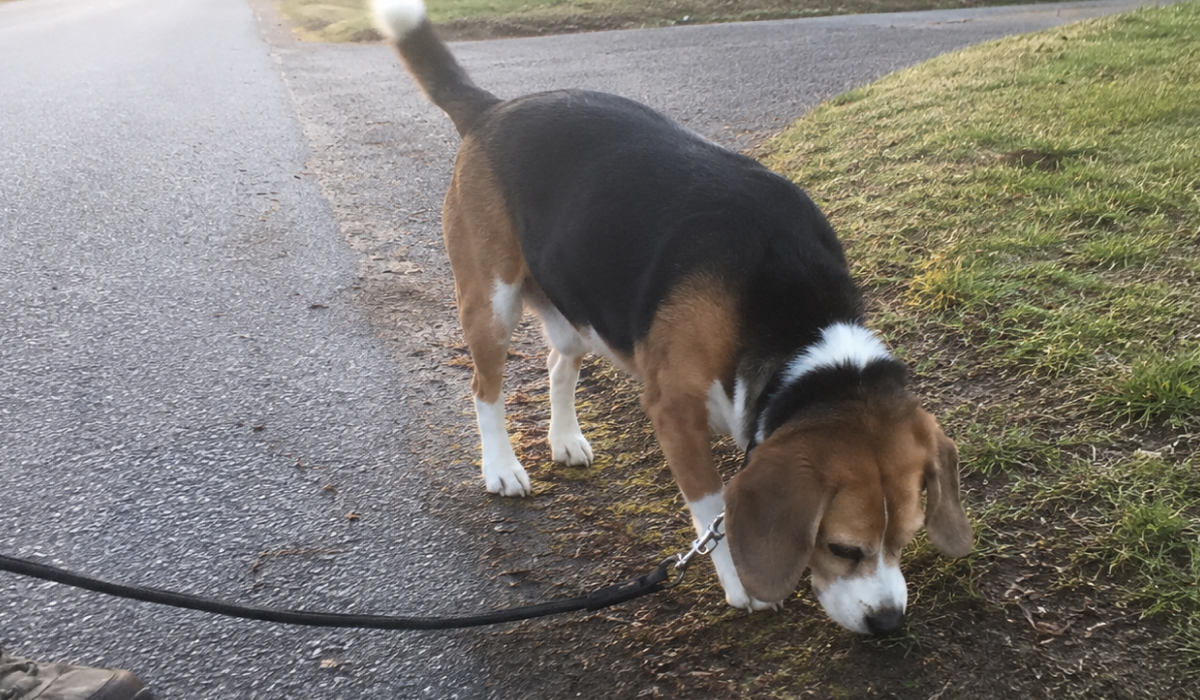
After Biscuit I felt like I had a reasonable handle on how to train a dog. Three years of work, a couple of obedience classes, a lot of repetition and patience and positive reinforcement — I knew the method, I’d seen the results, I felt confident going into it again. Rusty came home when Biscuit was about two years old, a beagle mix who had been at the shelter for a few weeks and had, according to the shelter notes, “a lot of personality.” I should have asked more follow-up questions about that phrase.
The first training session went fine. Sit, stay, basic stuff. Rusty watched me, appeared to understand what was being asked, did the thing, got the treat. I thought: okay, we’re in business. He’s smart. This will go smoothly.
The second session, about forty minutes later, Rusty had caught a scent through the back screen door and was no longer in the conversation. He was in the conversation technically — he was sitting there, he was looking approximately in my direction — but he had also detected something outside that required approximately ninety percent of his attention, and what was left over for me was not quite enough to work with.
This kept happening. Not because Rusty wasn’t smart — he is smart, genuinely, in ways that are occasionally inconvenient — but because the method I’d used on Biscuit was built on a specific Lab quality: the desire to get it right. Labs are what the training books call biddable, meaning they want to please you, and that wanting is powerful enough to compete with almost everything else in the environment. If you make it clear to a Lab what you want, she will try to give it to you because giving it to you is part of what she is.
Beagles are not built that way. Beagles were bred to follow a scent trail independently, without a hunter right next to them telling them what to do. The whole point of a beagle, historically, is that they run ahead and use their own judgment. Centuries of that breeding do not evaporate because you’re standing in a kitchen in Pittsburgh holding a treat. Rusty is not being stubborn when he checks out mid-session. He is doing what beagles do, which is prioritize his nose over everything else when his nose has something to say.
The specific training moment I still think about happened about six weeks in. We were working on “come” — recall, which is important for any dog and especially for a beagle you’re going to have off-leash anywhere. I’d done maybe four good repetitions, Rusty coming when called, getting a treat, the whole thing working. I thought we were making progress. I called him for the fifth rep and he started toward me and then stopped, mid-yard, turned his head ninety degrees, and walked in a completely different direction following something on the ground. I called his name. Nothing. I called it again, firmer. He glanced back at me briefly — I will give him that, he acknowledged that I existed — and then continued in the direction the scent was pulling him.
I stood there for a moment with a treat in my hand and nothing to do with it.
What eventually worked was shorter sessions. Much shorter — five minutes instead of fifteen, because the window where a beagle is fully present before the nose takes over is not a long window, and I was burning through it in the first third of what I’d been doing. High-value treats helped: Rusty responds to real chicken in a way he does not respond to standard training kibble. And picking battles — deciding which behaviors actually mattered and working on those rather than trying to shape everything at once.
“Come” is still not reliable off-leash. I’m not sure it ever will be, and I’ve mostly made my peace with that. What I have is a dog who comes when called about seventy percent of the time, with the remaining thirty percent being a negotiation that depends heavily on what he’s currently smelling. In a fenced yard, this is manageable. On a leash, it’s fine. In an open field it would be a problem, which is why Rusty is not in open fields.
What I learned, which I could have learned faster if I’d read more about beagle behavior specifically before I started, is that the same method doesn’t transfer across different breeds any more than the same coaching style transfers across different kids. Some kids need to be pushed, some need to be left alone to figure it out, some respond to one kind of encouragement and shut down under another. You pay attention to who you’ve got and you adjust.
I figured that out with the football kids eventually. Took me a little longer with the beagle. He’d probably say the same thing about me.
A thought from this morning, since the timing was good:
This morning, for the record, Rusty came when I called him on the first try. I called his name once, he looked up from whatever he was doing in the yard — something near the fence, I do not want to know what — and he came straight to me. No second call, no negotiation, no detour via something interesting on the ground. Just came. I gave him a piece of chicken and told him he was a good boy, which he accepted without false modesty. Then I went inside and he went directly back to the thing near the fence. So. Progress is not linear. But it is there, and I will take the moment for what it was.
Rusty is currently asleep on the couch in the exact center, equidistant from both armrests, taking up the maximum possible space for his size. Highly efficient. I’m in the chair. Yinz take what you can get.
__________________________
Hey, thanks for stopping by. This is just a place where I write about everything I’ve tried lately: old watches, the dogs, movies, interesting sports games, and any new app or website that catches my eye. Just one guy’s take, nothing more
Leave a Reply