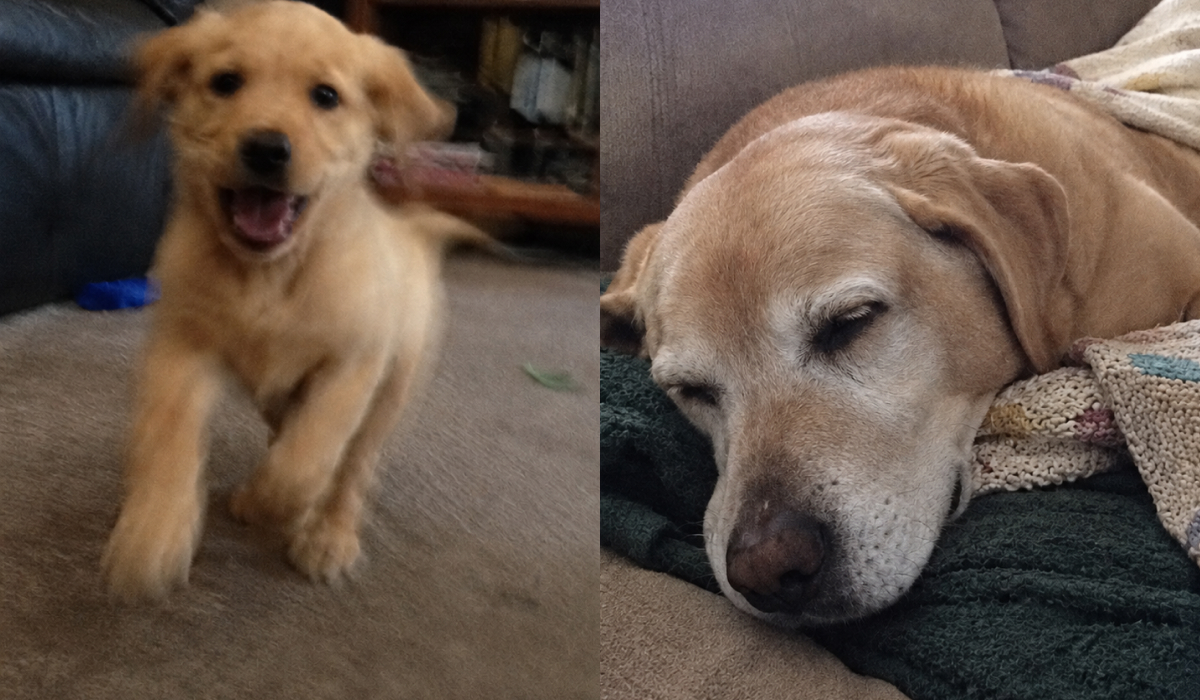
There is a version of getting a puppy that I had in my head before I actually did it, and then there is the reality of it, and those two things did not overlap as much as I expected.
I knew Labs were energetic. I had read about this. “High energy breed,” articles said, “needs plenty of exercise.” I took this to mean that I’d need to walk her more than I might walk a different kind of dog, and that there would be some running around the yard, and that I should probably invest in a durable toy or two. All of that was true. What the articles did not convey — could not convey, I think, because some things don’t translate from description to experience — was what it is actually like to live with a Labrador puppy in the sustained way that you live with a thing that is in your house every day.
Biscuit from eight weeks to roughly eighteen months was a kind of perpetual motion machine. She did not sit still in the way that a normal resting creature sits still. When she was lying down, she was lying down tensely, alert to any change in the room that might signal the possibility of movement, play, or food. She chewed through two dog beds and one corner of the kitchen baseboard, which I discovered and then redd up about three weeks after it happened because she had apparently been working on it gradually and I hadn’t noticed until there was a meaningful notch in the wood. She knocked over my coffee on a Tuesday morning in her second month with me, and I reacted in a way I’m not proud of, which she ignored completely, which was the correct response and probably something I should learn from.
The zoomies, if you don’t know what those are, are a thing Labs do — all dogs do it, but Labs do it at a scale worth mentioning — where they suddenly get a burst of energy and run in circles or figure eights at full speed for no apparent reason and then stop as abruptly as they started. Biscuit did this regularly, in the house, because I did not have a fenced yard yet, and this was before I sorted that out. The living room is not large. She is not a small dog. I moved things.
I enrolled her in a basic obedience class when she was about four months old, partly for the training and partly because I was told that socialization early on matters quite a lot for Labs, that getting them around other dogs and people when they’re young shapes how they are as adults. The class was on Saturday mornings at a place over on the north side, and for eight weeks I drove her there and we both did our best. She was attentive when she was attentive, which was perhaps sixty percent of each session. The other forty percent she spent watching the other dogs and deciding which one she most wanted to introduce herself to right now. The trainer was patient. I tipped her well at the end of the session.
The thing about coaching youth football — and I did it for about twelve years, off and on, with kids mostly in the eight to fourteen range — is that you learn quickly that different kids click at different times. Some kid comes in at ten and gets everything immediately, the footwork, the reads, the patience. Another kid comes in at twelve and spends two years not quite getting it, and then in one practice, it lands, and he’s a different player. You can’t rush it. You keep showing up, and you keep working, and you trust that the stuff you’re teaching is getting in there somewhere, even when it doesn’t look like it.
I think about that with Biscuit sometimes. Because somewhere around her second birthday, things started to change, and by three years old, she had settled into the dog she is now — focused when she needs to be focused, calm in the house, still enthusiastic about everything, but in a directed way rather than a chaotic one. The chewing stopped. The zoomies became occasional rather than daily. She started sitting with me in the evenings instead of next to me, doing her own restless thing.
I don’t know what happened internally. I don’t know if it was the training catching up, or the breed’s natural maturation timeline, or just the accumulated weight of three years of consistent routine. Probably all of it. The same way with the kids on the football field — eventually the pieces come together if you keep at it, and you don’t always know which specific thing made it click.
She is, as a companion, exactly what I hoped for when I decided to get a dog. Steady, warm, easy to be around, the kind of presence that makes a quiet house feel less like a quiet house.
It took three years, and I aged about ten. Worth it.
A current observation, since it is worth noting what nine years looks like:
I think about this sometimes in the evenings when she is next to me on the couch, and we are both just sitting there watching whatever is on. There is something specific about a dog that has been with you long enough that the two of you have developed a rhythm without deciding to. She knows when I am going to get up before I get up. She knows the difference between me walking toward the kitchen for coffee and walking toward the door to take her out, and she responds to each one differently. I do not know how she knows. I did not teach her. She just taught me for over nine years the same way I taught her, and now we move around each other in this house as we have always done, which I suppose we have. That did not happen in year one when she was chewing through the baseboard. It took time. Most things worth having to do.
Biscuit is currently doing her evening patrol of the kitchen, which she does regardless of whether anything interesting has happened in there. Some habits outlast the energy that created them. I respect that. It’s a good habit.
__________________________
Hey, thanks for stopping by. This is just a place where I write about everything I’ve tried lately: old watches, the dogs, movies, interesting sports games, and any new app or website that catches my eye. Just one guy’s take, nothing more
Leave a Reply