My father left me a Hamilton. A pocket watch, made in the 1940s, gold-filled case, manual wind. He had gotten it from his own father, who had gotten it from somewhere I do not know. By the time it came to me it had been through more decades than I had, and it still ran. Not perfectly, it gains about a minute a day, which is a known Hamilton thing, but it ran.
I put it on the shelf in my bedroom and looked at it occasionally and did not think much about it for a couple of years. Then I was at an estate sale in Shaler Township, looking at nothing in particular, and I found a Waltham pocket watch in a cardboard box under a folding table for eight dollars. It had a cracked crystal and needed cleaning but the movement looked complete and I knew from some half-remembered thing that Walthams were well-made. I bought it. I had no particular reason to. It just seemed wrong to leave it there.
That was the second one. The third came from a coworker at the factory who needed money before payday and had this old Illinois Railroad Grade watch he said had been his grandfather’s. Twenty dollars. I gave him the twenty, took the watch home, put it on the shelf next to the other two, and stood there looking at them for a minute and thought: well, apparently I am doing this now.
What I look for, which I worked out over about fifteen years of doing it wrong first, is this: original dial in decent condition, movement that runs or can be made to run, a case that has not been polished into oblivion. The polishing is the thing that kills value, in the unlikely event value is something you care about, which for most of what I have it is not. Somebody takes an old pocket watch case and polishes out all the wear, and suddenly it looks new and wrong and has lost everything interesting about it. I prefer them showing their age. They look like they have been somewhere. They have been somewhere.
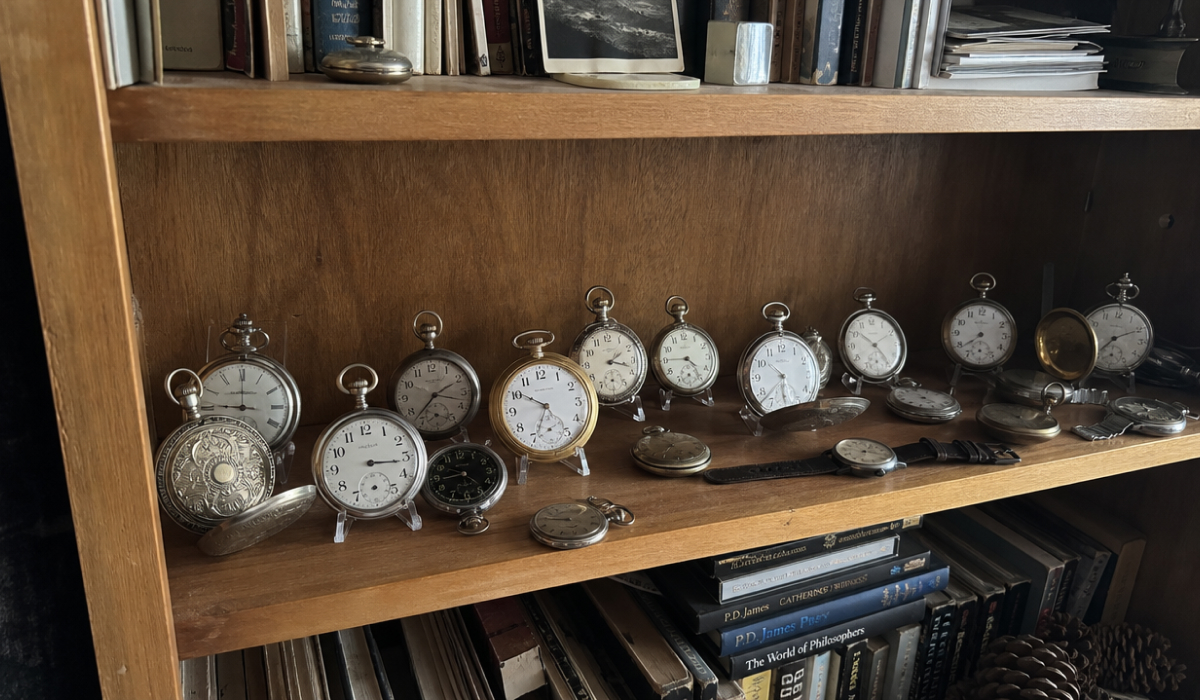
Most of what I have is American pocket watches from the late nineteenth and early twentieth century, Waltham, Elgin, Illinois, a couple of Hamiltons beyond my father’s. These are not rare. There were millions of them made. They came in enormous quantities to a country that needed to coordinate railroads and factories and keep workers on schedule. They are everywhere if you look at estate sales and flea markets, which I do, more than I probably should.
Four of the twenty-three are worth anything to anybody else in any meaningful dollar amount. My father’s Hamilton, mostly for what it is, not what it would sell for. An Elgin seventeen-jewel railroad grade I found in a junk box that cleaned up into something quite nice. A Hamilton 992B railroad pocket watch that I paid more than I should have at an estate sale on the north side because the case was in remarkable condition and I have made my peace with the price. And a small Swiss lady’s watch from around 1910 that I got cheaply because the seller did not know what she had, I knew because I had spent enough time looking at these things that I recognized it.
The rest are what they are. Perfectly good watches, all of them running or runnable, all of them worth something to me, none of them going to pay for anything significant. I did not buy them as an investment. I do not think of them as an investment. I think of them as the only category of object I have accumulated over sixty-three years that I actually want to keep looking at.
They live on a shelf in what used to be the spare bedroom, the one that has been a home office for about fifteen years now. I have had to add a second shelf. I am starting to think about a third, which is either a sign that I should stop going to estate sales, I am not a gumband-and-cardboard kind of collector, but I am very much myself when it comes to watch cases in cardboard boxes, or a sign that I need a bigger shelf, and I know which one I am going to choose.
The Hamilton from my father is in the middle of the top shelf. Everything else is arranged around it, loosely, by type and era. It still gains a minute a day. I wind it on Sundays, which was the day my father wound it, which is a detail I did not decide to preserve and yet there it is.
A thought on why the Hamilton gains a minute and why I have not fixed it:
A watchmaker could regulate it. It is a simple adjustment, a matter of moving the regulator slightly, and the watch would keep better time. I have thought about having it done more than once. I have not done it. The watch gains a minute a day because that is how it came to me and something about changing it feels like editing the object. My father knew it gained a minute. He wound it anyway. I know it gains a minute. I wind it on Sundays anyway. The minute is part of it now. That probably does not make sense to anyone who has not held on to something that belonged to someone they lost, but I think it makes enough sense to the people who have.
__________________________
Hey, thanks for stopping by. This is just a place where I write about everything I’ve tried lately: old watches, the dogs, movies, interesting sports games, and any new app or website that catches my eye. Just one guy’s take, nothing more
Leave a Reply